
Later-living community models: Ireland vs the world

Photo Credit: Talha Uguz
Heritage Village is Ireland’s first modern later-living community. Developer Tommy Keane knew that there needed to be somewhere for the ageing population of Ireland to feel safe, secure and thrive in their later years. He wanted to give people somewhere to downsize to from their large family homes, thus Heritage Village was born.
Sales Manager, Maurice Harrington (who you will have the pleasure of meeting upon your visit to Heritage Village), felt inspired to get involved in this project after seeing a lack of alternative housing available to his mother when she received an Alzheimer’s diagnosis in 2011.
Their vision when creating Heritage Village was to create a space that feels both calm and connected. A place where people can enjoy the privacy of their own home, the company of good neighbours and the reassurance of support whenever it’s needed. Designed for comfort, connection and peace of mind, Heritage Village represents a new chapter for over 55s in Ireland. Later-living communities are a relatively new concept to Irish shores but they have been sprouting up in different areas across the globe from as early as the 1950s.
Thanks to scientific advances in the medical field combined with lifestyle changes, the Irish life expectancy has increased from 65.52 years in the 1950s to 83.27 years in 2026 but we need to provide suitable housing options for our ageing population that suits their every need.
Throughout this blog, let us explore the different types of later-living models across the United Kingdom, United States, New Zealand and Australia and compare them with the unique lifestyle, services and support offered at Heritage Village.
Background
The United Kingdom
Our closest neighbours have been in the game of later-living options since the 1970s, offering designated private rental apartments and bungalows for retired people. This model has continued to expand and since the 1990s the later-living landscape in the UK has boomed. The modern concept of lifestyle-focused retirement villages with on-site care and leisure facilities emerged in the late 90s/ early 00s and has grown into a multi-billion pound sector. With an approximate population of 68 million people, the UK has a number of different types of retirement housing options for those looking to keep their independent, active lifestyle. From John O’Groats to Land’s End, there is something for everyone.
The United States
When people think of retirement living or later-living solutions, they think of the setup that they have in the United States, Florida in particular, where older residents spend their days with new friends on the golf course with care facilities on-hand if needed. Retirement villages and age-restricted communities became a part of the mainstream housing offering in the United States during the 1950s and 1960s, driven by a landmark development in Youngtown, Arizona. The development in Youngtown is recognised as the first planned, age-restricted community in the U.S., where residency was explicitly limited to older adults. As of 2026, there are approximately 30,600 assisted living and residential retirement communities in the United States, according to industry data from the National Center for Assisted Living.
Australia
According to McCrindle, there are over 2,200 later-living/retirement villages, providing accommodation for over 170,000 people over the age of 55 across Australia. Approximately 8% of Australians aged 75+ live in one of these villages. The push factors for new residents were to downsize while they still could (84%), their home was becoming too big to manage (62%), and concern about their future health (60%). The pull factors were that they could stay independent (87%), they had a safe environment with 24/7 support (87%) and were able to access village facilities (87%).
New Zealand
According to AgedAdvisor.nz, New Zealand has approximately 491 retirement and later-living villages, containing around 43,598 units. In a country of just over 5 million people, similar to ourselves in the Republic of Ireland, approximately 50,000 Kiwis live in later-living communities or residential care, representing a concentrated and highly engaged population whose needs change as they age. Downsizing from big family homes that require constant maintenance and care is one of the largest push factors for Kiwis aged 55 and over.
It is a combination of these factors that inspired our team to create Heritage Village. Seeing the thriving later-living communities around the world and the lack of similar facilities available in Ireland showed them that there needed to be such models available here. Prior to Heritage Village, a lot of residential care options for older people were in care-based models that often stunt day-to-day freedom and routine, with later-living communities focusing on active social engagement rather than heavy medical care.
Comparison Charts
CCRC (Continuing Care Retirement Community)
How Heritage Village differs
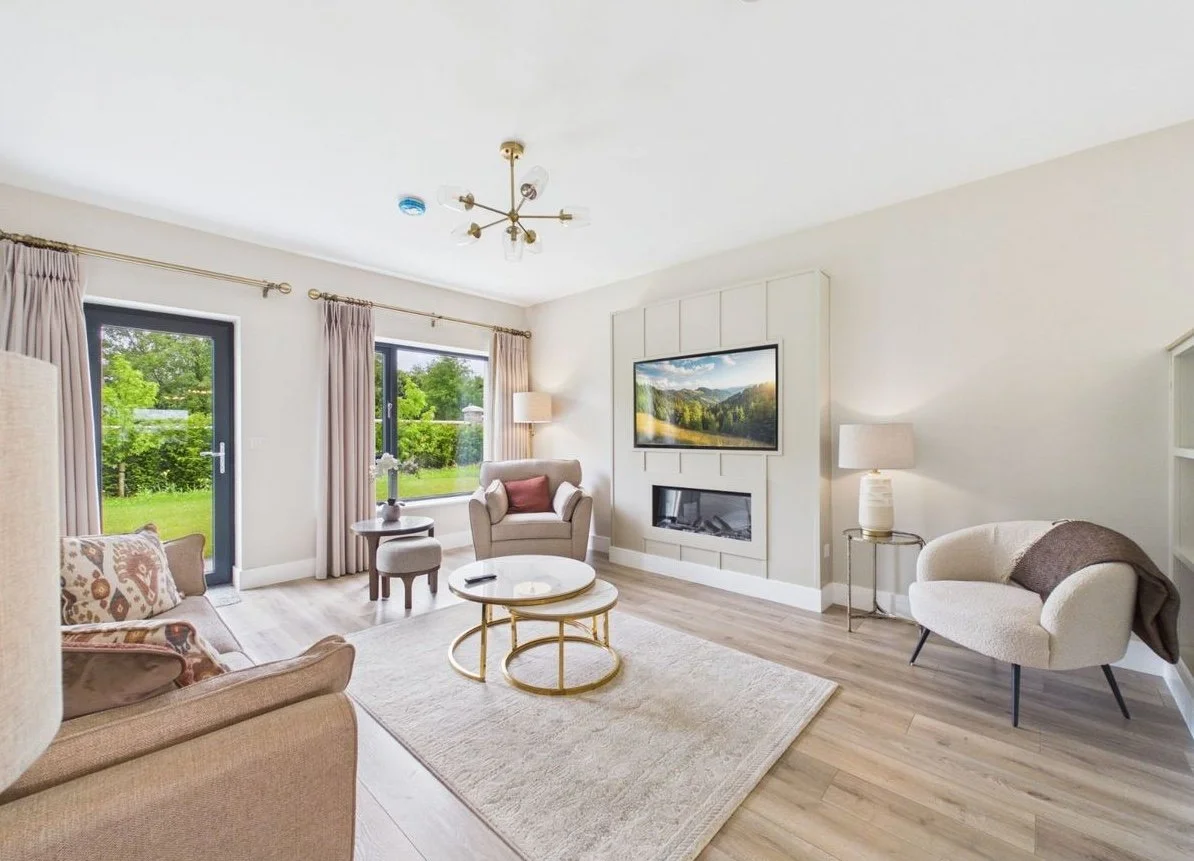
The most significant distinction between other later-living models around the world and what we have available in Heritage Village Killenard is the ownership model.
Looking at later-living communities around the world, Heritage Village shares many of the features that have made this style of living popular internationally, while also doing a few things differently.
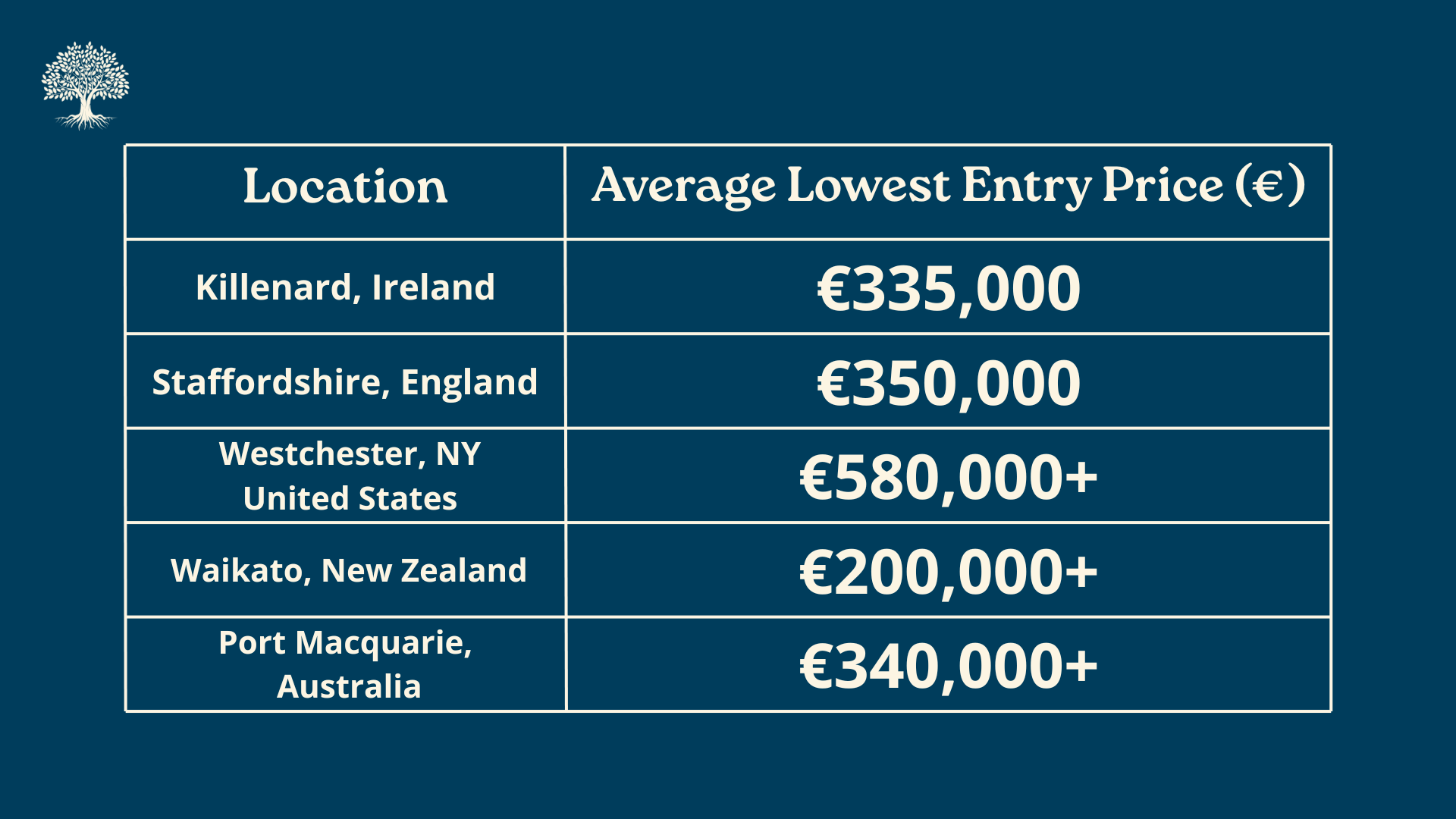
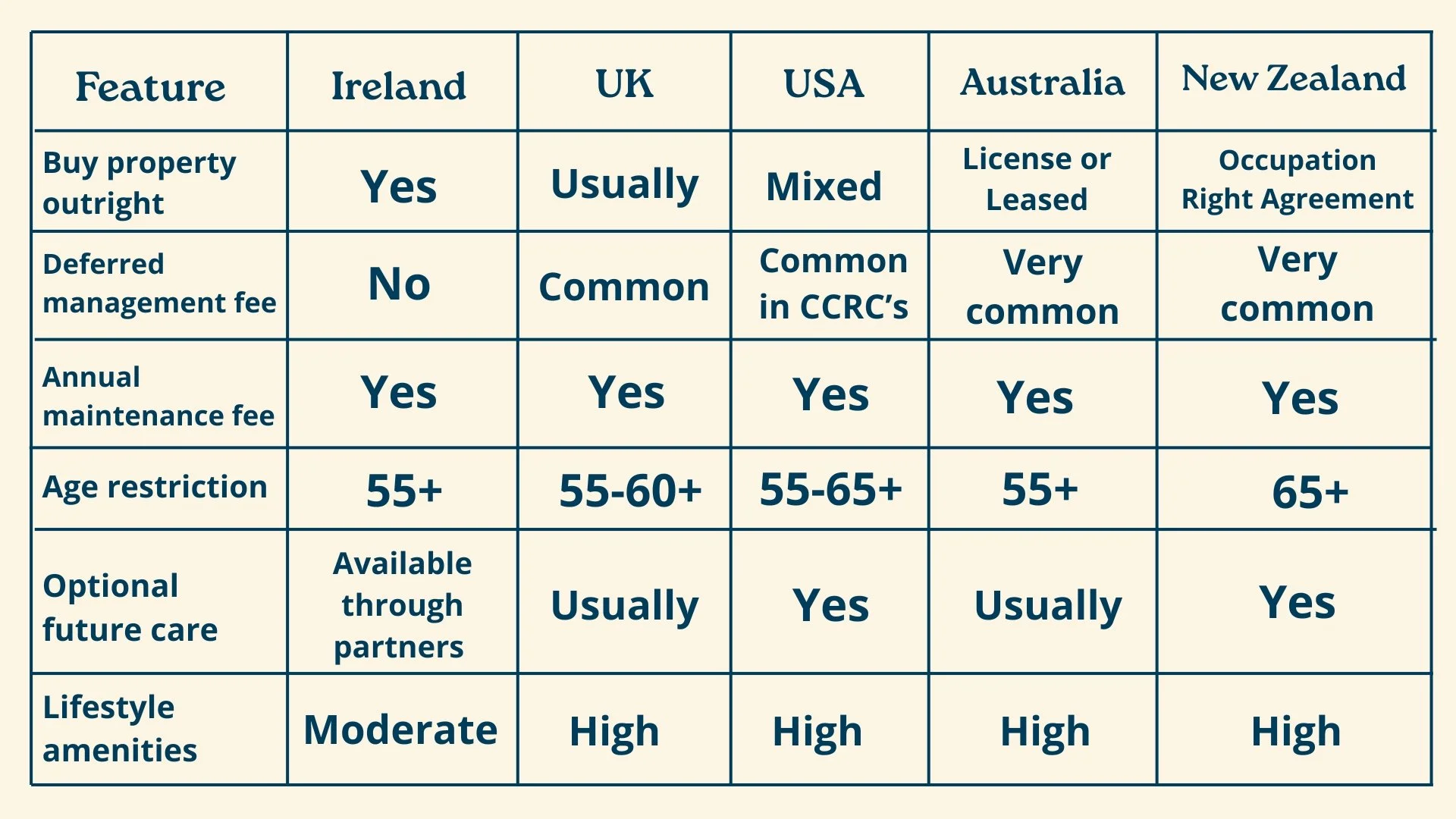
One of the biggest differences is affordability. The cost of buying a home in Heritage Village is generally lower than many premium retirement villages in countries like the UK and Australia. Residents also own their home, rather than purchasing a licence to occupy, which is a common model in a number of overseas retirement communities.
Another notable difference is what happens if you decide to sell. In Australia and New Zealand, many retirement villages charge a deferred management fee when a property is sold, often reducing the amount the homeowner receives from the sale. Heritage Village doesn't have this type of fee, which makes the costs of moving on much easier to understand.
There are annual maintenance fees to help cover the upkeep of the community, but these are straightforward and designed to be predictable, so you will know what to expect.
Perhaps the biggest distinction, though, is the overall approach. Heritage Village is built around independent living, with an emphasis on enjoying a low-maintenance home and being part of a community, rather than moving into a care-focused environment. It reflects a growing trend of downsizing by choosing a home that better suits your lifestyle while keeping the independence that comes with homeownership.
In many ways, it combines the benefits people value in established later-living communities around the world, such as a sense of community, lower-maintenance living and the ability to stay in the same home as needs change; with an ownership model that may feel more familiar to many buyers.
